Tuesday, March 13, 2012

The English Whitman

Martin Tupper was many things: an Oxford man, a devoted Christian, a chauvinist of the Anglo-Saxon race, a barrister and constantly in close proximity to high society people in both America and the United Kingdom. With such qualities, why was he ever compared to Walt Whitman? In his paper "Martin Tupper, Walt Whitman, and the Early Reviews of Leaves of Grass" Matt Cohen explores the similarities and differences of the two poets. 

When Leaves of Grass was first published it wasn't read by many people due to the unusual style of the book: it didn't have a title or the name of the author. However, many of those who did have a chance to stumble upon Whitman's masterpiece were quick to compare it to Tupper's Proverbial Philosophy. Many critics who read Whitman's blank verse compared in to Tupper's style of writing. Tupper became popular in both the UK and America, however, like Whitman's Leaves of Grass, Proverbial Philosophy took several decades to become popular. When it did become popular, Proverbial Philosophy, was part of Walt Whitman's collection of books; today the same copy with notes from Whitman can be found in the Library of Congress.

Even though the two characters seem to be people of very different interests, Tupper the upper class-man and Whitman the wannabe b'hoy, their writings have some striking similarities. After reading some of Tupper's poetry it becomes evident how Whitmanesque his writing is, or is Whitman's writing Tupperesque since the later came first?

"Man liveth from hour to hour, and knoweth not what may happen;
Influences circle him on all sides, and yet must he answer for his actions:
For the being that is master of himself, bendeth events to his will,
But a slave to selfish passions is the wavering creature of circumstance."
-Tupper.

“this is thy hour o soul, thy free flight into the wordless, 
away from books, away from art, the day erased, the lesson 
done, 
thee fully forth emerging, silent, gazing, pondering the 
themes thou lovest best, 
night, sleep, death and the stars.” 
- Whitman. 


SD: Ferries

Before the Brooklyn Bridge and the metro connected New Yorkers from various boroughs, the ferry system was a convenient and infinitely useful tool of transit. The Fulton ferry got it's name from Robert Fulton who established the Fulton Ferry Company in 1814. Today, a neighborhood in Brooklyn is named after the place where the ferry docked.

Whitman mentions the importance of ferries in his daily life, he tells us that he himself identifies the Fulton ferry as an important characteristic of those days: "Indeed, I have always had a passion for ferries; to me they afford inimitable, streaming, never-failing, living poems."

The ferry inspired and captivated Whitman, it connected him  to rivers, nature and the city. Whitman could have taken the ferry to the Battery to have a drink with some b'hoys or to Long Island to spend some time by the sea. In those days ferries and steam boat were also important ways of transporting goods around New York City, up the Hudson or down the Mississippi. In the 19th century they have had an undeniablyvast impact on society and industrialization.


Monday, March 12, 2012

PopWhitman


Edward Norton paid an ode to Walt Whitman by producing and staring in modern film version of Leaves of Grass. The plot is centered around a set of twin brothers who lead two very opposite lives: Bill is a professor dedicated to all things academia, Brady is a hick dedicated to all things marijuana.  Bill is told that Brady was killed with a crossbow, so he goes to Oklahoma to pay his respects, when he gets there he finds Brady alive and well. Bill meets a local girl who tells him a thing or two about poetry:

 
The movie has many themes that appear in Whitman's poetry: the dignity of any sort of labor, freedom granted to us  by nature, the connection that grass has created for all living things, the beauty and wholeness of life and the incredible gift of being alive. The use of twins as main characters demonstrates the unnatural nature that people have created for mankind. The nature of being twins suggest that all humans share a likeness due to the fact that we all come from the same place and walk the same earth; however, the difference in the twins character shows how society manifests unnatural borders that separate people from one another and nature.


 The other day was my friends birthday, as one of her present she got a gay mug. When not in use the mug looks has doors around it. When the mug is filled with hot coffee or tea, the doors fade away and magically reveal the portraits of some legendary men and women who happened to be gay. Among them Oscar Wilde, Gertrude Stein and of course Walt Whitman. 


Many musician's have been inspired by Walt Whitman Poems. These include Bob Dylan, The Smiths, and Billy Bragg & Wilco. Billy Bragg & Wilco wrote a nice little bluegrass tune about Whitman's niece. The lyrics are reminiscent of Whitman's poems with innuendos duality and loafing. The song is lacking any type of meter or rhyme scheme like  most of Whitman's poetry.


Tuesday, March 6, 2012

Reviews

The first review that interested me was Edward Everett Hale's for The North American Review.
The first part of the review discusses the unique style of Leaves of Grass. Hale is fond of the poetic prose but is at odds with the arrangement of the book because the first edition didn't have any mention of a publisher nor the author which was so unusual that the bookstore clerk didn't even know the book existed. Hale assures the reader that if the clerk wasn't able to find the book the first time it was worth coming back a second time. It seems that Leaves of Grass made a good impression on Hale, yet, he is confounded on how to receive a work so different from the standard style of poetry. Whitman changed the rules by publishing Leaves of Grass, some praised the originality of the work, others were struck off guard by the change.

Later in review Hale assesses some of the writing from "Song of Myself". This part of the review was especially interesting because Hale was able to make connections between some verses and events of the 1850's, a connection few modern day readers could make.

"Here is the story of the gallant seaman who rescued the passengers
      on the San Francisco:—
'I understand the large heart of heroes,
The courage of present times and all times;
How the skipper saw the crowded and rudderless wreck of the steamship,
      and death chasing it up and down the storm.'"

Even though the verse above makes it implicit what had happened, the 1850's reader would have been touched more by this reference. Also, Hale draws our attention to the vividness of the the text, the certainty with which Whitman describes eventsmakes it seem as though he was present when they happened. However, in the 1850's being in as many different places as Whitman describes was rare for any one person, so Hale questions the validity of the observations. Eventually Hale comes to the conclusion that the validity isn't what matters, what does matter is the visual Whitman can put into a readers head. The way Whitman describes events takes the reader to the meadow, to San Francisco, to New York city; Whitman's writing takes the reader across a continent which is a luxury most people in those days couldn't afford otherwise.

Hale, Edward Everett. "[Review of Leaves of Grass (1855)]." The North American Review 82 (January 1856): 275-7. 

 The next review i found really confused me because I hadn't  realized that Walt Whitman himself wrote the review. I  found this odd for several reasons. For one,he author of the review is calling Whitman an arrogant and egotistical person. Next it seems that the review is mocking Whitman's proximity to nature, the poetic prose and Leaves of Grass as a whole.If I am correct and Whitman did indeed write this review than it kind of makes  Whitman seem like a bipolar masachyst. Why else would he write a book of poem in which he spills his heart out, finds tranquility with himself and the world, only to have disdain for it in the end?

Perhaps this is how the poet "grows". Whitman became his own worst critic. This duality of thinking, being the poet and the critic, is what creates Whitman's bipolar style of writing in which he constantly contradicts himself.

This next review shows the interest and excitment with which Leaves of Grass was greeted by some. Charles Eliot Norton describes Walt Whitmans's poetry as,"a compound of the New England transcendentalist and New York rowdy".  Whitmans poetry seems pretty subtle in it's style to today's readers but I imagine that over a hundred and fifty years ago the public received the text with some shock. Whitman described nature in a different way than his contemporaries had, he used words and ideas that were unfamiliar to the public at that time. "... but that he was a kosmos, is a piece of news we were hardly prepared for. Precisely what a kosmos is, we trust Mr. Whitman will take an early occasion to inform the impatient public."
Today we have a much better grasp of the existential and transcendential ideas Whitman was speaking of becuase we are familair with them now but in the 18th hundreds they were just beginning to formulate. 


 Norton, Charles Eliot. "[Review of Leaves of Grass (1855)]." Putnam's Monthly: A Magazine of Literature, Science, and Arts 6 (September 1855): 321-3.

Friday, March 2, 2012

SD: A VISIT, AT THE LAST, TO R. W. EMERSON

It turns out that Walt Whitman was fortunate enough to have a slumber party at R. W. Emerson's house. United by a common love for ponds, Ralph and Walt have been inspiring people to take a walk through the wilderness ever since. The two buddies spent their time chatting and reading letters from Ralph's friend Henry Thoreau.


These three men have an incredibly positive influence on America. The only person missing from the party is Abraham Lincoln,  had he not been assasinated fifteen years prior I'm sure he would have participated as well.
Walt Whitman's close proximity to these men can be seen through out his poetry. Thoreau's revolutionary ideas of civil disobedience against a government that stops working for the people can be seen throughout Whitman's "A Song for Occupations", in passages such as:


"The sum of all known reverence I add up in you whoever you are,
The President is there in the White House for you, it is not you
         who are here for him,
The Secretaries act in their bureaus for you, not you here for them,
The Congress convenes every Twelfth-month for you,
Laws, courts, the forming of States, the charters of cities, the
         going and coming of commerce and mails, are all for you." 


All three of these men are renounced for their unique literally contributions and a transcendental view of life and culture. There can never be enough people like Walt, Ralph and Henry.

Tuesday, February 28, 2012

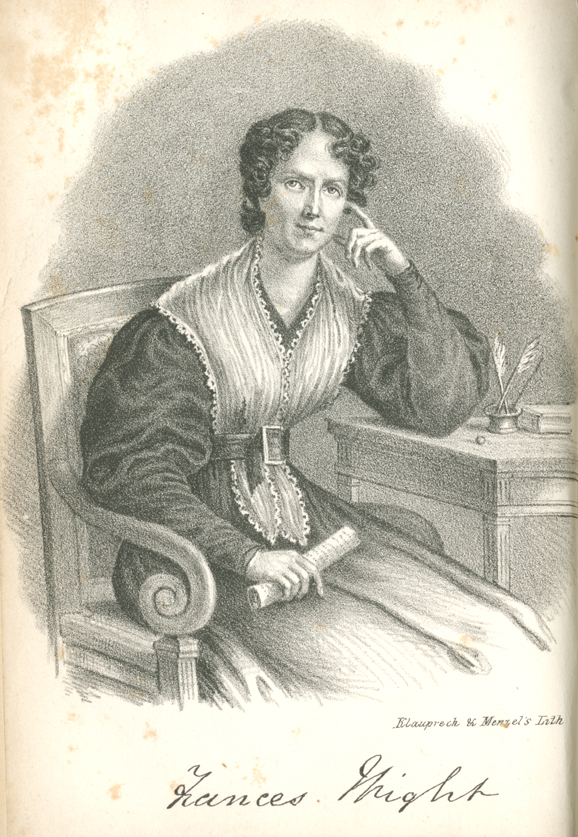
Fanny


This is the first time that I've heard of Frances Wright which is unfortunate because she is a hero that should be paid tribute to in American history. Fanny is an exemplary American; an abolitionist, entrepreneur and free thinker. She lived the American dream by coming to the States from Scotland as an orphan and eventually becoming an influential and popular figure in American society. She became known through her written work for the press, concentrated in solutions for creating a slave-free society. Wright also participated in the establishment of a "utopian" community. Wright didn't believe in organized religion, still a controversial subject.

Walt Whitman was a fan of Fanny's work. He called Wrights novel A Few Days in Athens his "daily food". The novel is a translation if a Greek work about a young man, Theon.

All in all, Wright was an influential woman who challenged common ideology and proposed radical and transcendental ideas for the transformation of society.


Chants Democratic


 Top Row: Whitman, You, Me, Whitman, Whitman, You, You, Me, Me,
Whitman, Whitman
Middle Row:  You, Me, Whitman, Whitman, Me, Me, Whitman, You, Whitman, Me, You, Me, Whitman, Whitman, You, You, Me, Whitman, Whitman 
Front Row: You, Me, Whitman, Whitman, You, You, Me, Me,
Whitman, Whitman, Me, You, Whitman
Left Most: Whitman, You

The loafer empowers the working man! The working man is the loafer? Or is the working man the working man? 
Whitman says "it's all good, I'm not gonna judge you, don't judge me, we are all in this together, you my friend are what makes the world go around."


I think this poem is another look at how dynamic Whitman was.
"Come closer to me..." has a different name for it in every edition of Leaves of Grass. The poems location in the poem also vary.


1856 "Poem of the daily workmen and work women of the United States"  2nd poem in Leaves of Grass.
1860 "Chants Democratic "  appears near beginning.
1867 "To workingmen." appears middle closer to end.
1872  "Carol of Occupations" midway through the edition.
 1881- 1882 "A song for Occupations" middle of the edition
1891-1892  "A song for Occupations" middle of the edition.


 As the poem shifts further into the reading, it can be argued that it's importance becomes less significant. I say this because of the way our memory works, people are more likely to remember the beginning and end of a sequence rather than the middle. So if someone happened to read the book cover to cover the poems in the middle would probably resonate less with the reader. 


On the other hand, Whitman constantly changed the name of this poem so it must  have some special significance to him. Maybe it was because he as, the loafer, found a special balance in this poem by addressing
the working man and woman.

 This poem goes through some serious changes between 1855 and 1882. Many lines are added which add a significantly stronger address to the worker.


for example:
"If you stand at work in a shop I stand as nigh as the nighest in
         the same shop"


Perhaps, as Whitman got older he became more interested in his community rather than himself and nature.
 Or maybe since he wasn't a laborer he felt more grateful and passionate about the work of others. Historicaly, after the Civil War workers rights became one of the central concerns in cities. In the 1870's strikes and riots began to occur in major cities like Boston, New York and Chicago. The 1880's and 1890's saw several massacres due to workers striking, including the 1887 strike in Chicago of more than 50,000 workers. 300,000 workers assembled to strike across America on May Day ( May 1st. 1886) for the 8- hour work day.

The Haymarket massacre of 1886 fallowing a strike in Haymarket Square, Chicago:


(Looks like Whitman was on top that day)


This poem shows how unconditionally patriotic and passionate Whitman was in the affairs of American people. I feel that this poem would have worked best in the end of the book because it would have been the perfect inspiring and patriotic ode to the average American woarker. 


"We consider the bibles and religions divine . . . . I do not say they are not divine,
I say they have all grown out of you and may grow out of you still,
It is not they who give the life . . . . it is you who give the life;
Leaves are not more shed from the trees or trees from the earth than they are shed
         out of you. "